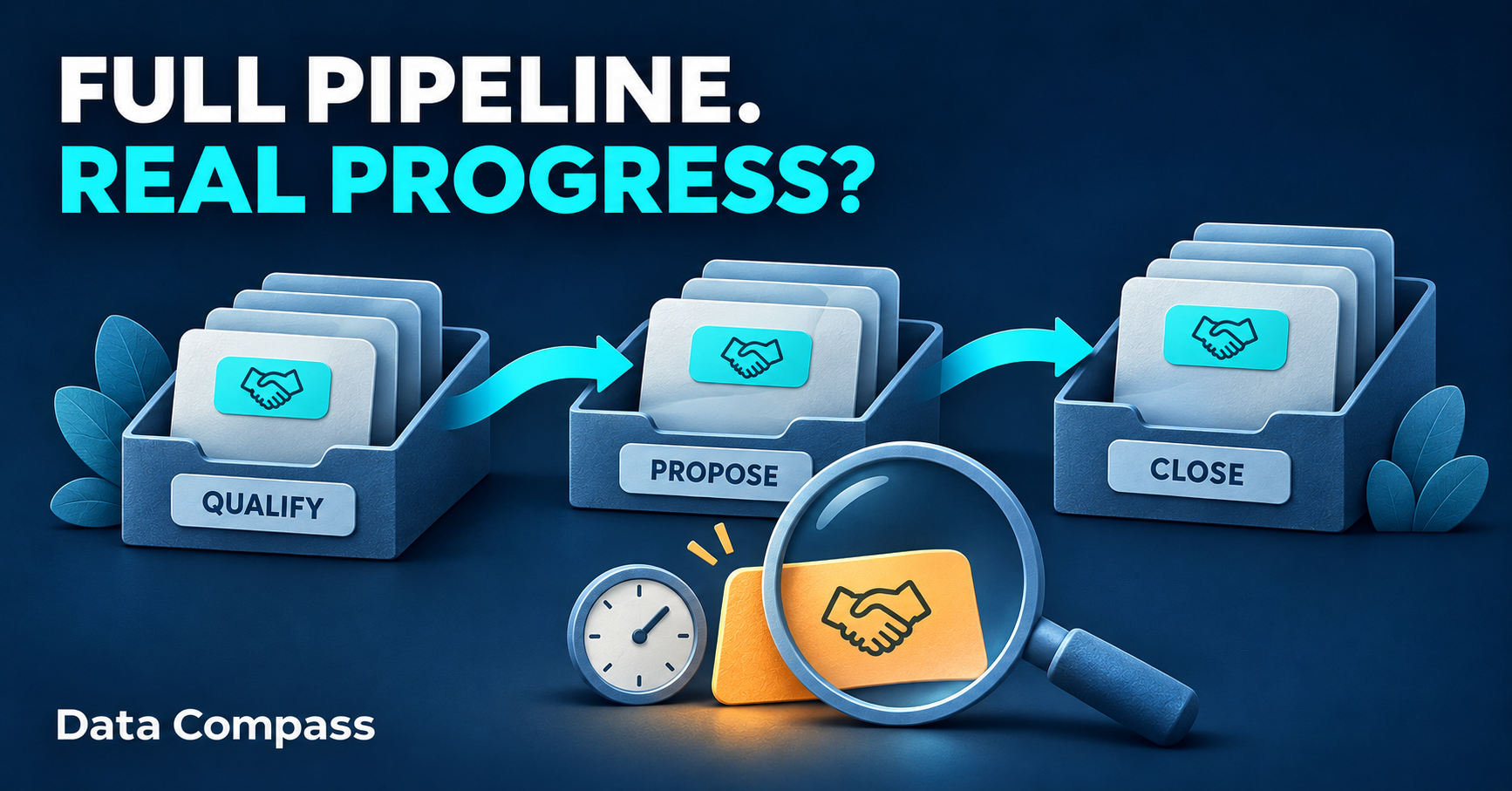
A full pipeline can look reassuring. Until the same opportunities appear in every sales meeting, with another new closing date.
The value is still there. The progress is harder to find.
A stalled sales deal is an opportunity that is no longer showing the progress you would reasonably expect towards a buying decision. Time in a stage can flag it for review. The buyer's actions and the next agreed step help you decide what is actually happening.
The useful question is simple: which deals need a conversation this week?
Start with time in the current stage
Look at when each opportunity entered its current stage. That is different from when the opportunity was first created or when someone last edited the record.
A deal opened six months ago might have reached negotiation yesterday. Another opened last month might have spent nearly all that time waiting for a response to a proposal. Their overall age will not tell you that difference.
Compare the time with similar deals in your own business. Consider the stage, type of customer and size of purchase. A large procurement process and a small repeat order should not automatically share the same deadline.
There is no universal number of days that makes a deal stalled. If your records are limited, agree a provisional review point with the sales team and improve it as you learn. Treat it as a prompt to investigate, rather than an automatic reason to close the deal.
Ask what the buyer has actually done
Activity on your side does not necessarily mean movement on theirs.
Three follow-up emails show that your salesperson has followed up. They do not establish that the buyer is closer to a decision. Equally, a quiet period might be perfectly reasonable if the buyer has explained that a committee meets next Thursday.
For each flagged deal, ask:
- What was the last meaningful response or action from the buyer?
- What needs to happen before the deal can move forward?
- Has that next step been agreed with the buyer, and does it have a date?
Compare two illustrative opportunities. Both have spent 18 days at proposal stage. In one, the buyer has booked a review meeting for Tuesday and invited the budget holder. In the other, several messages have gone unanswered and the next action says only "chase".
The stage duration is identical. The evidence of progress is not.
Use a short review list
You do not need a complicated dashboard to begin. Put these details in one view:
| Detail | What it helps you understand |
|---|---|
| Opportunity and owner | Who is responsible for the conversation |
| Current stage and date entered | How long this part of the process has taken |
| Last meaningful buyer response | Whether there is evidence of engagement |
| Agreed next step and date | What progress should happen next |
| Expected close date | Whether the forecast still matches the conversation |
Review the list with the people who own the deals. Missing information is a reason to clarify the record, not proof that the buyer has disappeared.
You may discover a reporting issue too. If colleagues use "proposal" to mean different things, time in that stage will be difficult to compare. Agree what must be true before a deal enters and leaves each stage. Salesforce's pipeline guidance also recommends clear stage exit criteria.
Finish with a decision for each flagged deal
The review should lead somewhere. Agree one of three outcomes:
- Keep it active, with a specific next step and a realistic date.
- Move it out of the near-term forecast because the buyer has deferred the decision. Record when and why you will revisit it.
- Close it as lost when the evidence supports that conclusion, recording the reason.
Do not keep moving the close date simply to keep the number in this month's forecast. But do not close a viable opportunity just because it has crossed an arbitrary age threshold either.
The aim is a pipeline your team can explain. Some deals will take longer. What matters is whether you understand the delay and have a credible next action.
Try this at your next sales meeting
Choose one stage, pull out the opportunities that have been there longer than expected, and ask the three buyer-progress questions above.
Start small enough to act on what you find. A shorter list of credible opportunities is more useful than a larger total nobody can confidently explain.
Data Compass helps business and sales leaders make sense of pipeline performance through sales analytics. If your pipeline report raises more questions than it answers, .
Further reading: Salesforce — Build a healthy sales pipeline.